
- Pathstone MBA: Unlock Your Career ROI
- MBA Online
- MBA vs MiM: Differences, Costs, and Career Outcomes Explained
MBA vs MiM: Differences, Costs, and Career Outcomes Explained
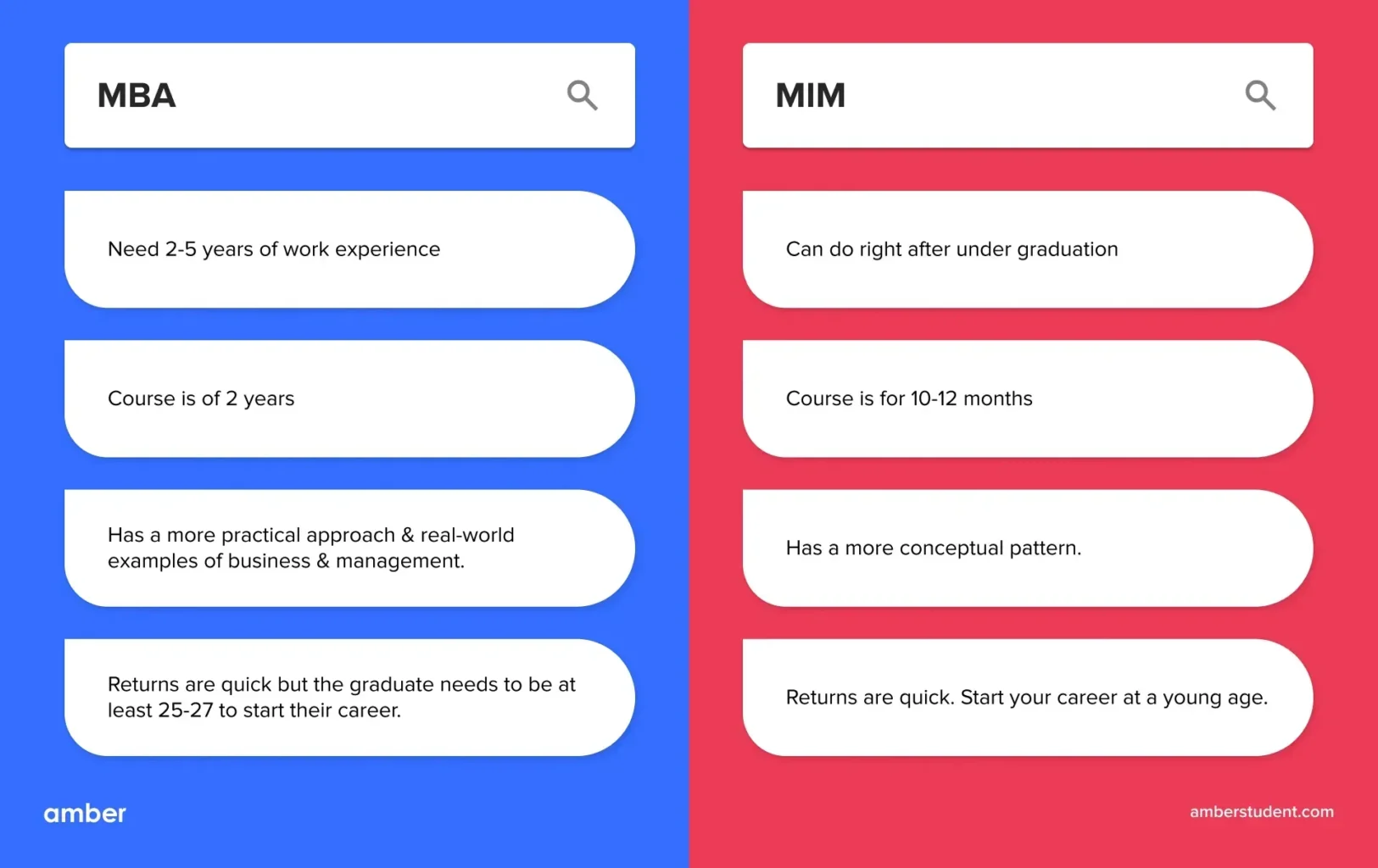
Choosing between an MBA and a Master in Management, often called a MiM, is one of the most important decisions prospective business students can make. Both degrees can improve your professional profile, expand your business knowledge, and open the door to stronger career opportunities. However, they are not designed for the same type of student, and they do not usually lead to the same short-term outcomes.
That is where many applicants get confused.
At first glance, the two programs can seem similar. Both cover core business topics. Both can lead to jobs in management, consulting, finance, marketing, operations, or strategy. Both are offered by respected business schools around the world. And both can strengthen your long-term earning potential.
But the differences are significant.
An MBA is typically aimed at professionals who already have substantial work experience and want to accelerate their careers, move into leadership, change industries, or increase their salary potential. A MiM, by contrast, is generally designed for recent graduates or early-career professionals who want a strong foundation in business and management before building deeper professional experience.
That distinction affects everything else: admission criteria, classroom profile, curriculum depth, salary expectations, networking opportunities, return on investment, and long-term career outcomes.
If you are deciding between an MBA and a MiM, the right choice depends on where you are in your career, what kind of roles you want next, how much work experience you already have, and how much you are willing to invest in your education.
This guide breaks down the key differences between an MBA and a MiM, including costs, student profiles, structure, and career outcomes, so you can make a confident and informed decision.
What Is an MBA?
An MBA, or Master of Business Administration, is a postgraduate degree designed to help professionals develop advanced business, leadership, and strategic management skills.
MBA programs usually focus on areas such as:
Finance
Marketing
Strategy
Operations
Leadership
Organizational behavior
Economics
Entrepreneurship
The MBA is often viewed as a degree for career advancement. Many students pursue it after spending several years in the workforce because they want to move into management, switch industries, gain broader business expertise, or qualify for more senior roles.
MBA cohorts are usually made up of professionals with meaningful work experience. That means class discussions, group projects, and case studies often rely heavily on real-world business perspectives and peer learning.
This is one of the defining characteristics of an MBA: it is not just an academic degree. It is also a professional development experience built around leadership, decision-making, and applied business thinking.
What Is a MiM?
A MiM, or Master in Management, is a postgraduate business degree aimed primarily at recent graduates and early-career professionals.
It is designed to provide a broad understanding of how businesses work and how management functions across areas such as:
Accounting
Finance
Marketing
Strategy
Human resources
Operations
International business
Organizational management
The MiM is often seen as a bridge between undergraduate study and the professional world. It gives students a structured introduction to business concepts, analytical thinking, and management fundamentals, even if their first degree was in a non-business subject.
For example, a student who studied engineering, psychology, economics, literature, or political science may choose a MiM to gain commercial knowledge and improve employability.
Compared with an MBA, the MiM usually places less emphasis on executive leadership and more emphasis on foundational business education.
MBA vs MiM: The Core Difference
The simplest way to understand the difference is this:
An MBA is usually for experienced professionals.
A MiM is usually for recent graduates or those with limited work experience.
That core distinction shapes the entire student experience.
An MBA assumes you already understand how organizations work from inside. It builds on that experience and helps you operate at a more strategic, managerial, or executive level.
A MiM assumes you may have strong academic potential but limited exposure to the business world. It helps you build a broad commercial base so you can enter the job market with more confidence and direction.
Neither degree is inherently better. The better option depends on your starting point and your goals.
Who Should Choose an MBA?
An MBA is generally best suited to people who:
Have several years of work experience
Want to move into leadership or management
Plan to switch industries or functions
Want stronger salary growth
Need a broader strategic view of business
Are looking for high-value networking with experienced professionals
Want to strengthen executive presence and decision-making skills
Common MBA candidates include:
Engineers moving into management
Consultants aiming for senior roles
Finance professionals seeking leadership positions
Entrepreneurs wanting to scale a business
Mid-career professionals pivoting into new sectors
Managers seeking promotion into director-level roles
An MBA tends to make the most sense when you already have a career foundation and want to accelerate or redirect it.
Who Should Choose a MiM?
A MiM is usually best for people who:
Have little or no full-time work experience
Recently finished a bachelor’s degree
Want to build strong business fundamentals
Need a credential to improve employability
Want to enter business-related roles early in their career
Are not yet ready for the cost or profile of an MBA
Common MiM candidates include:
Recent graduates in non-business disciplines
Early-career professionals with one or two years of experience
Students seeking entry-level roles in consulting, finance, marketing, or operations
International students wanting a recognized business qualification
Graduates who want to delay an MBA until later in their career
A MiM is often a smart first step for ambitious students who want a business education but have not yet built enough professional experience to fully benefit from an MBA.
Admission Requirements: MBA vs MiM
One of the clearest differences between the two degrees appears in the admissions process.
MBA Admission Requirements
MBA programs often require:
Several years of professional work experience
A bachelor’s degree
A CV or résumé
Essays or personal statements
Letters of recommendation
Evidence of leadership potential
Sometimes GMAT or GRE scores
Sometimes interviews
Many MBA programs evaluate candidates not only on academic ability but also on career progression, leadership qualities, achievements, and future goals.
MiM Admission Requirements
MiM programs often require:
A bachelor’s degree
Strong academic performance
A personal statement
Sometimes internships or limited work experience
Sometimes GMAT or GRE scores
Sometimes language proficiency for international applicants
MiM admissions usually place more weight on academic potential and less on managerial track record because candidates are earlier in their careers.
In simple terms, MBA applicants are often judged more like professionals, while MiM applicants are often judged more like high-potential graduates.
Curriculum Differences
Although both degrees cover business topics, the depth, focus, and classroom assumptions are different.
MBA Curriculum
MBA programs typically emphasize:
Strategic decision-making
Leadership and people management
Real-world business problem solving
Executive communication
Organizational transformation
Negotiation
Applied finance and strategy
Cross-functional decision-making
MBA students are often expected to contribute practical workplace insights to class discussions. The teaching style may include case studies, peer debate, simulations, consulting projects, and leadership exercises.
The content is usually designed to help students operate in more complex business environments and manage broader responsibilities.
MiM Curriculum
MiM programs typically emphasize:
Core business knowledge
Management theory
Analytical tools
Business communication
Market understanding
Teamwork and project-based learning
Entry-level professional readiness
A MiM often provides more structure around fundamentals because students may not yet have deep business exposure.
This can be especially useful for recent graduates who want a broad introduction to the language and logic of business before specializing later.
Costs: MBA vs MiM
Cost is one of the most important factors when comparing the two degrees.
In most cases, an MBA is significantly more expensive than a MiM.
Why MBAs Usually Cost More
There are several reasons:
MBA programs are often positioned as premium career-acceleration degrees
They are targeted at professionals with higher earning potential
They may include stronger career services, executive coaching, and alumni access
They are often delivered by business schools with premium branding
Their perceived salary impact is often higher
Why MiMs Are Often More Affordable
MiM programs are generally cheaper because:
They are aimed at earlier-career students
Their market positioning is closer to an advanced graduate degree than an executive accelerator
Salary uplift expectations are usually lower in the short term
They may be shorter and less resource-intensive in some cases
That said, cost varies widely by country, school reputation, program format, and duration.
A top global MiM at an elite business school can still be expensive, and some online or regional MBA programs can be relatively affordable. So the comparison should not be based on labels alone.
Think Beyond Tuition
When comparing cost, consider:
Tuition and fees
Cost of books and materials
Living expenses if studying on campus
Opportunity cost if leaving full-time work
Lost income during study
Travel costs for residencies or international modules
Financing and loan terms
For many students, the true cost of a degree is not just the price on the website. It is the total economic impact of earning it.
Career Outcomes: MBA vs MiM
Career outcomes are where the distinction becomes especially important.
Both degrees can lead to excellent opportunities, but they usually do so at different career stages and with different starting points.
Career Outcomes After a MiM
A MiM often helps graduates secure strong entry-level or early-career roles in fields such as:
Consulting
Marketing
Finance
Business development
Operations
Project coordination
Sales
Strategy analyst roles
Management trainee programs
For many graduates, the MiM improves employability, broadens access to recruiters, and creates a more business-ready profile.
Typical outcomes include:
Faster entry into business careers
Better access to graduate schemes
More competitive positioning compared with candidates who only hold a bachelor’s degree
Stronger long-term career foundation
However, MiM graduates are usually still entering the market at a relatively junior level. The degree may help them get a better first job, but it does not usually place them directly into senior leadership roles.
Career Outcomes After an MBA
An MBA often supports career outcomes such as:
Promotion into management or senior management
Transition into consulting, finance, or leadership tracks
Career change into a new industry or function
Salary increases
Access to more strategic or client-facing roles
Greater credibility for entrepreneurship or business growth
MBA graduates may move into roles such as:
Product manager
Strategy manager
Operations manager
Marketing director track roles
Consultant
Business development manager
Finance manager
General manager
Startup founder or growth lead
The MBA is often associated with faster upward mobility because candidates already bring existing professional experience. The degree adds leverage to an established profile rather than replacing the need for experience.
Salary Potential: MBA vs MiM
Salary is not the only measure of success, but it is often a major consideration.
In general, MBA graduates tend to report higher salaries than MiM graduates. However, this is not just because of the degree itself. It is also because MBA students typically start from a more experienced professional base.
A person with six years of work experience plus an MBA will usually enter the market at a higher level than a recent graduate with a MiM.
That means salary comparisons should always be interpreted in context.
MiM Salary Reality
A MiM can improve your starting salary compared with having only an undergraduate degree, especially if it helps you enter competitive sectors or top employers.
But MiM salaries are usually tied to early-career roles.
MBA Salary Reality
An MBA can often deliver a stronger immediate salary increase, especially for professionals who:
Move into management
Join higher-paying industries
Switch into consulting or strategic roles
Use the degree to reposition themselves
Still, salary outcomes vary by geography, school quality, prior experience, industry, and economic conditions.
The right question is not just which degree pays more. The better question is which degree gives you the best return at your stage of career.
Networking and Peer Value
Networking is one of the most underestimated differences between the two programs.
MBA Networking
In an MBA, your peers are usually experienced professionals. That means your network may include:
Managers
Engineers
Consultants
Entrepreneurs
Analysts
Executives
International professionals with real workplace responsibility
This can be extremely valuable if you want peer learning, business contacts, partnerships, or access to industry insight.
MiM Networking
In a MiM, your peers are more likely to be:
Recent graduates
Early-career professionals
Interns
International students building their first business network
This is still valuable, especially for long-term relationships, but the immediate professional leverage may be different from what you get in an MBA setting.
An MBA network often has more immediate seniority. A MiM network often has strong long-term potential.
ROI: Which Degree Offers Better Return on Investment?
Return on investment depends on your personal situation.
A MiM may offer better ROI if:
You are early in your career
You want a relatively affordable business degree
You want to boost employability quickly
You do not yet qualify for a strong MBA
You want to build a business foundation before gaining experience
An MBA may offer better ROI if:
You already have work experience
You are aiming for a salary jump or promotion
You want to switch industries
You value high-level networking
You need a degree that supports leadership progression
The wrong degree at the wrong time usually produces weak ROI.
For example, doing an MBA too early in your career may limit its value because you will not fully contribute to or benefit from the peer-level experience. On the other hand, waiting too long to build business foundations might delay your progress if you are a recent graduate trying to enter competitive sectors.
International Perception and Market Differences
The MBA and MiM are not perceived exactly the same way in every market.
In many parts of Europe, the MiM is highly established and widely respected as a strong early-career management qualification. In the United States, the MBA has historically been more dominant, though MiM programs have gained visibility. In global markets, both degrees are increasingly recognized, but employer familiarity can still vary by region and industry.
This matters if you plan to work internationally.
You should consider:
How well known the degree is in your target country
Whether employers in your chosen market understand the distinction
How the school is perceived regionally and globally
Whether the alumni network is strong where you want to work
A globally recognized school can sometimes reduce uncertainty regardless of degree type.
Common Misconceptions About MBA vs MiM
“The MBA is always better”
Not true. An MBA is not automatically better if you are a recent graduate with little work experience. In that case, a MiM may be the smarter and more efficient choice.
“The MiM is just a weaker MBA”
Also not true. A MiM is a different product for a different audience. It is not a failed version of an MBA. It is often a highly respected qualification in its own right.
“Both degrees lead to the same jobs”
Not exactly. There can be overlap, but the level of entry and the pace of progression are often different. MiM graduates usually enter earlier-career roles, while MBA graduates often target mid-level or more strategic positions.
“The cheaper option is the better option”
Only if it aligns with your goals. A lower-cost degree that does not move you toward your career objective may be more expensive in the long run.
How to Decide Between an MBA and a MiM
A simple way to decide is to ask yourself these questions:
1. How much work experience do I have?
If you have very limited full-time experience, a MiM is often the stronger fit. If you have several years of professional experience, an MBA is usually more appropriate.
2. What type of role do I want next?
If you want to enter the business world and build a foundation, the MiM may be ideal. If you want leadership, promotion, or a career pivot, the MBA may be more effective.
3. What is my budget?
If cost is a major concern and you are early in your career, a MiM may offer strong value. If you can justify a higher investment through likely salary growth or promotion, an MBA may be worth it.
4. Am I looking for foundational learning or career acceleration?
That question often provides the clearest answer.
Foundational learning: MiM
Career acceleration: MBA
5. Is now the right time?
Timing matters. Even a great degree can underperform if taken at the wrong point in your professional journey.
Final Thoughts
The choice between an MBA and a MiM is not about which degree is more prestigious in the abstract. It is about which degree makes more sense for your current profile and future goals.
Choose a MiM if you are at the beginning of your career, want strong business fundamentals, and need a degree that helps you enter the market with more confidence and credibility.
Choose an MBA if you already have meaningful work experience and want a degree that helps you move up, change direction, increase your salary, or step into leadership.
Both degrees can be powerful. Both can improve your trajectory. Both can create long-term value.
But the best choice is the one that matches your stage, your ambition, and your return-on-investment logic.
Do not choose based on reputation alone. Do not choose based on assumptions. Choose based on fit.
When you understand the differences, costs, and career outcomes clearly, the decision becomes much easier. And once you choose the right degree for your situation, you are far more likely to turn that investment into real professional progress.
Leave a Reply